The cycle and perpetuation of tyranny
The KillerThe cycle and perpetuation of tyranny becomes the governing meaning of the play’s ending: Macol defeats Macbett amid public cries for liberation, takes the throne, and then promises a rule more vicious and painful than the one he has ended. The reversal makes political change look less like escape from tyranny than a transfer of its instruments. Macbett falls, but the guillotines, public slogans, threats, and demand for obedience remain available to the next ruler.
The overthrow presented as liberation
The transition begins with the crowd’s repeated cry, “Down with Macbett! Long live Macol!” Fanfares announce Macol’s entrance, and Macbett declares, “I fear no one.” The contrast is immediate: the public has already aligned itself with the returning challenger, while Macbett’s confidence cannot prevent his isolation. The play presents his fall as a change in power supported by collective acclamation, not as a quiet or private succession.
Lady Duncan identifies Macol as Duncan’s son, newly returned from Carthage with a large army, and tells Macbett that the whole country is against him. She then directs Macol to kill the “unclean man” and discard the sword afterward. Her instruction frames the killing as both vengeance and an attempt to separate the avenger from the violence he must use. But the scene does not establish such a clean break: Macol takes power through the same decisive force that has marked Macbett’s rule, and the sword remains central to the transfer.
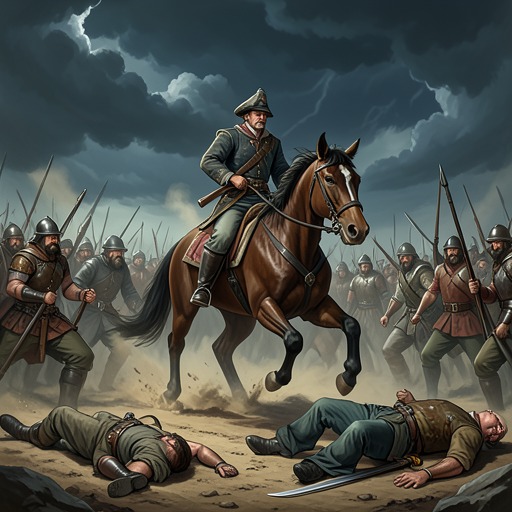
The challenger and the ruler exchange insults before the confrontation turns to prophecy. Macbett insists that no man of woman born can harm him, then claims that he can be defeated only when the forest marches against him. These assurances make his power seem protected by conditions he believes cannot be fulfilled. The staged answer is literal and public: men and women enter carrying placards with trees drawn on them, while the stage direction says that ideally the set itself should move forward and encircle the two men. Macol points out that the forest is on the march; Macbett turns, and Macol stabs him in the back. The prophecy that seemed to place Macbett beyond defeat becomes the means by which his defeat is recognized and enacted.
From victory to a new sovereignty
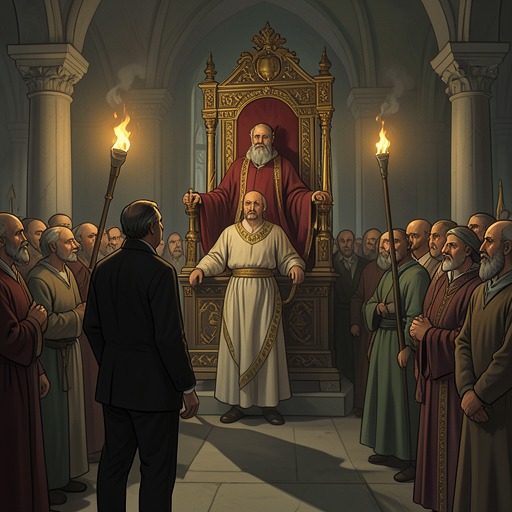
After Macbett falls, Macol orders that the body be taken away. Shouts offstage declare the tyrant dead and hail Macol as the beloved sovereign. The throne is brought on as Macbett’s body is carried away, making the substitution visible in the staging: the dead ruler leaves while the seat of rule arrives. A guest invites Macol to sit, and other guests raise placards reading “Macol is always right.” The proclamation of a new sovereign thus quickly acquires the language of unquestionable authority.
The crowd also cries, “Long live Banco's dynasty!” alongside its acclamation of Macol. The juxtaposition links the new regime not only to the victory over Macbett but to a continuing dynastic claim. Bells sound, a bishop appears, and Macol asks whether he has come to crown him. The sequence surrounds the seizure of power with ceremony and public recognition. Yet that formal validation does not demonstrate that rule itself has changed: the emphatic slogan, the throne, and the anticipated crowning establish a new ruler while leaving the underlying hierarchy intact.
Macol then addresses the country as a liberator. He says it sank beneath a yoke and suffered fresh wounds each day, claims to have trodden on the tyrant’s head, and describes wearing it on his sword. As he speaks, a man appears carrying Macbett’s head on a pike. The image gives physical form to the announcement’s triumphal language: the defeated ruler is displayed as proof that the old power has been broken. But the pike also keeps political victory inseparable from public violence. Macol’s account asks the people to read the killing as deliverance, even as the spectacle preserves the coercive force by which sovereignty has changed hands.
The explicit renewal of tyranny
The decisive reversal comes after this rhetoric of rescue. Macol threatens to set his soldiers and dogs on anyone who will not be quiet. A forest of guillotines appears upstage, as it did in the First Scene, bringing the instrument of state violence back into view at the moment the new ruler asserts control over speech. The recurring image connects Macol’s rule to the play’s earlier political world: the tyrant has changed, but the threat of execution has not disappeared.
Macol then declares that the country will have more vices and suffer more than ever under his succession. His promise directly contradicts his preceding account of rescuing the country from its wounds. Rather than offering a restrained hope that the new reign might improve on the old, he announces that it will intensify the harms he has attributed to Macbett. The reversal is not merely implied by the reuse of the throne or the return of the guillotines; Macol states the continuation and worsening of tyranny himself.
The crowd responds with murmurs of discontent, amazement, and despair as the announcement continues. The ending therefore separates popular celebration from popular consent: the voices that hailed Macol’s victory do not greet his declared program with a renewed chorus of approval. At the end of the speech, Macol is left alone. His accession has been publicly staged and ceremonially prepared, but the final image withdraws the crowd’s apparent unity and leaves the sovereign isolated with the rule he has promised.
Meaning of the cycle
The ending makes the cycle of tyranny a sequence of recognizable substitutions. A ruler is denounced, defeated, and displayed; a successor is acclaimed, seated, and prepared for coronation; slogans that once celebrate deliverance become formulas of obedience. Macol’s victory initially appears to fulfill the people’s demand to be rid of Macbett, but his threats and announcement expose the limits of that change. The country has exchanged rulers without escaping the practices through which rulers dominate it.
The repeated stage images sharpen this argument. The throne passes from one sovereign to another, while the returning forest of guillotines points back to an earlier scene and forward to the violence Macol threatens. The tree placards first make the forest prophecy theatrically visible; the later guillotines turn recurrence into a political warning. Together, the props and slogans make succession feel less like a new beginning than a replay with different names attached to power.
The cycle is therefore neither a hidden outcome that the audience must infer nor a promise of reform that remains uncertain. Macol himself announces that the country will suffer more under him, and the crowd’s despair registers the consequence of that announcement. The final solitude does not undo his accession; it leaves the newly enthroned ruler in place while exposing the hollowness of the liberation he claimed. Macbett’s death ends his reign, but it does not end tyranny.